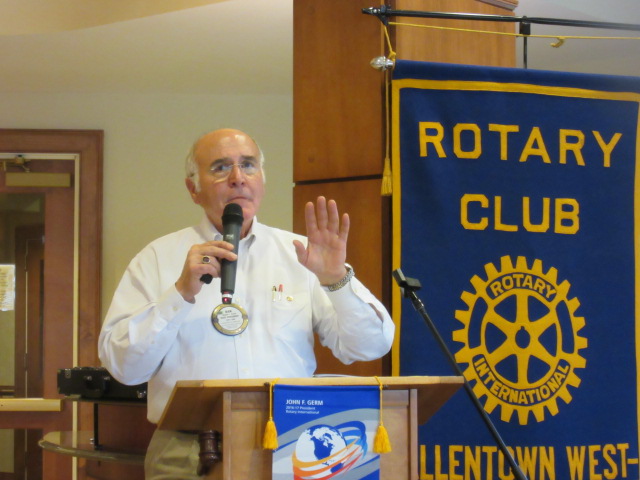
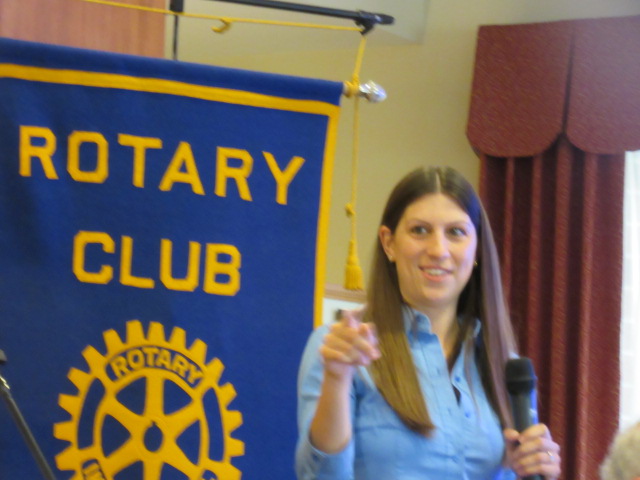
Our Greeter today was Amir Famili and he did a marvelous job.
President Dan Crane rang the bell at 7:33 A.M. (Tsk, Tsk) to open the meeting. Jean Machamer gave a very nice invocation.
The assembled voices sang a good rendition of our National Anthem along with a flag video. And we said the pledge of Allegiance.
President Dan says the word from the country is “Baseball is ninety percent mental and the other half is physical. “ said Yogi Berra.
GUESTS:
Wilmer Schultz, Emmaus RC; Dr. Jennifer Stinson.
NEW MEMBER INDUCTION:
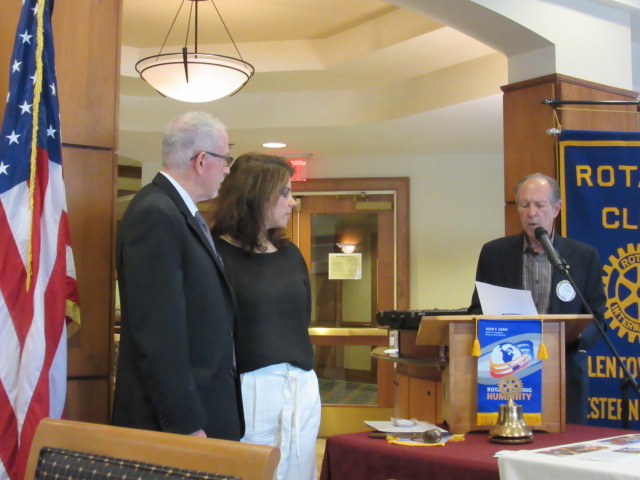
Christina (Tina) Buss was inducted as an active member of the AWRC, Chuck Ehninger conducted the formal ceremony. Bob Gordon is Tina’s sponsor.
President Dan showed many slides of photographs from our last meeting starting with a copy of the certificate that charters the new Snack Pack Community Corps initiated by Gloria Zimmerman.
Then we saw pics from the last Wednesday morning and Thursday evening meeting. And there were many photos from the Sunday Iron Pigs baseball game.
A NEW OPPORTUNITY FOR SERVICE:
June 17th, Saturday, we can volunteer at the Lehigh Valley Zoo for an event which features children's activities. Barbara Kistler will keep a list of volunteers and folks can sign up for two hour blocks of time from 10:00 AM to 4:00 PM. We will be helping with the children's activities/crafts or helping with the animal exhibits. Deadline is June 3.
Zoe David, an LCCC student to whom AWRC gave a scholarship, sent us a very nice Thank You note. She will attend Kutztown University.
SCHEDULE:
Dan continues to e-mail us an updated list of volunteer opportunities and future events.
Our next Thursday Evening meeting will be on June 8th at the Pub at the Holiday Inn starting at 5:30 P.M. It is a Business Card Exchange Mixer.
Saturday June 3rd Gloria needs volunteers for the Food Pantry.
June 7th -- Charter night dinner for the new RC of Upper Perkiomen.
June 14th is work at the Lowhill Food Pantry.
June 19th is the closing ceremony at Camp Neidig. We hope to have a student speak at our June 21st meeting.
Jun 28th -- AWRC Changeover meeting.
Jun 30th is DINING OUT at Nostos Greek Restaurant at 701 N. 19th Street in Allentown, 6 PM start; free glass of wine, or BYOB.
AND, of course, you always can have your breakfast at our meetings sitting with Arch Klumph for a donation of $26.50 --- or more --- to the Rotary Foundation. Over half of our members have done this.
NEXT WEEK our Greeter will be Ihor Fedoriw and the program is Chris Blechschmidt & Herb Klotz presenting the Allentown West Rotary Club Financials for 2017-18.
LUCK of the DRAW:
S-a-A Don Davis collected some fine money from Dan Crane who had a number of “boo boos” this morning.
The door prize, donated by Amir Famili was won by Donna Beach.
The $65 of the 50:50 pot was not won by Gil Keller’s ticket being drawn.
HAPPY DOLLARS:
Bob Gordon is happy that Tina Buss now is a Rotarian.
Dr. Bob also is happy that seven years of work have culminated in yesterday’s publication of an International manual for Psychologists.
Bill Palmer is happy to report that the YTD new cases of Polio Myelitis remains at 5. We are Soooooooo close!
Jean Machamer is happy that her granddaughter recently returned safe from her trip to England.
Gloria Zimmerman is happy that AJ Henry now is home and ready for visitors.
Don Davis told a good joke.
Mitch Huston also told a good joke.
John Scott’s daughter is 10 years old today.
Halyna Stegura’s bike riding daughter, Christina, is heading for Disneyland today.
Ralph Witcher, as usual, is just plain happy.
Dale Hostetter is having a birthday and claims he added wrong and is one year younger.
Jerry Frank offers thanks to the AW members for the support of the Iron Pigs event. About $1,200 was raised.
Jerry also is happy for his fantastic Parkland H.S. softball playing granddaughter who is completing her third winning season with a district championship game tomorrow. She has batted over .500, had no errors and only one strikeout in 25 games. In the Fall she will attend the University of Scranton on scholarships.
PROGRAM:
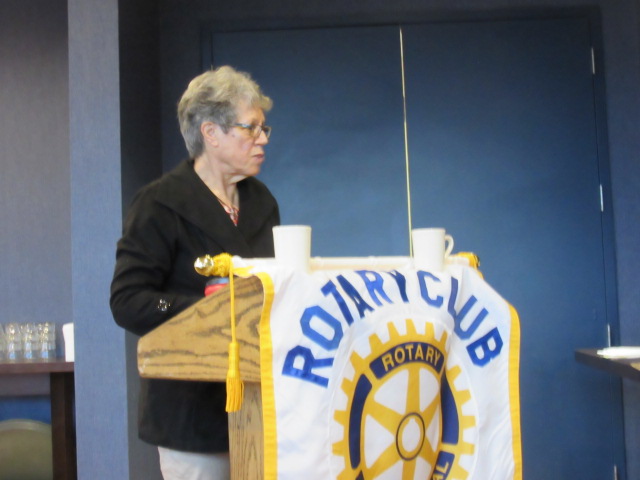
Today was Melissa DelVecchino, Physical Therapist at Good Shepherd. Her subject is Joint Replacements of the Knee and Hip—What to expect.
President Dan Crane introduced Melissa DelVecchio, DPT, MBA, who graduated from Penn State with a Bachelor’s degree in Kinesiology.
She received her Doctorate in Physical Therapy and Masters in Business HealthCare Management from Weidner.
Melissa has been a practicing Physical Therapist at Good Shepherd since 2012 and is currently practicing out of the CedarPointe location. She treats both orthopedic and neurological conditions in patients of all ages. Melissa specializes in manual therapy for neck and low back pain, as well as headache therapy.
Melissa used a series of slides and two videos to explain the Knee and Hip replacement stories. She noted that in 2015 there were about 7 million people now living with Knee and Hip replacements in the U.S.
IMPLANT MATERIALS
During replacement surgery, a surgeon will resurface your damaged knee with artificial components, called implants.
The metal parts of the implant are made of titanium or cobalt-chromium based alloys. The plastic parts are made of ultra high molecular weight polyethylene. Some implants are made of ceramics or ceramic/metal mixtures. Implants will weigh between 15 and 20 ounces.
They are biocompatible- they can be placed in the body without creating a rejection response.
They are able to duplicate the joint structures they are intended to replace. They are strong enough to take weight bearing loads are flexible enough to bear stress without breaking.
TOTAL KNEE REPLACEMENT (TKR)
A normal knee functions as a hinge joint between the upper leg bone and the lower leg bone. The surfaces where these bones meet can become worn out over time.
These 3 joint surfaces may be replaced:
1. The lower femur (metal).
2. The top surface of the tibia (metal platform with a cushion of polyurethane).
3. The back surface of the patella (polyurethane).
In some cases, the patella does not need to be resurfaced.
LIGAMENTS
In a healthy knee the ligaments provide stability.
In a replaced knee all ligaments are generally removed.
Parts of the implant substitute for the removed ligaments.
Components are designed so that metal always borders with plastic, which provides for smoother movement and results in less wear of the implant.
TOTAL HIP REPLACEMENT (THR)
The hip joint functions as a ball and socket joint. There are two sides, a ball (the femoral head), and the socket (the acetabulum). When the hip joint becomes arthritic, the normally smooth cartilage surface is worn away.
The femoral head is removed and replaced by a metal femoral stem (ball is screwed into place).
The acetabulum is resurfaced and fit with an acetabular cup and a polyurethane liner is snapped into place.
THE APPROACH
The hip can be accessed in different ways called the approach.
Most surgeons use a posterior approach (going through the back of the hip).
Becoming more popular is the anterior approach (going through the front of the hip).
There are pros and cons of each approach and little science to endorse one over the other. Surgeons tend to have a preference and comfort level with one particular approach over the others.
HOW LONG IS THE HOSPITAL STAY?
You will likely stay in the hospital for 1-3 days depending on how fast you progress with physical therapy.
This is highly dependent upon your condition before surgery, your age, and medical problems which can hinder your rehabilitation.
Most surgeons today emphasize getting you out of bed quickly. Most people are walking with the assistance of a walker on the day after surgery, and using a cane or nothing at all by 2-3 weeks.
ARE THERE COMPLICATIONS?
Complications happen in 1-5% of patients including…
Infection (1%) is one of the most debilitating complications and often requires prolonged antibiotics with several additional surgeries to rid the infection.
A blood clot in the leg (relatively common) requiring some type of blood thinner following surgery to reduce the incidence.
Failure of the implant over time due to wear of the bearing components or loosening of the components from the bone, both of which usually occur over many years.
Dislocation specific to hip replacements (1%) that may require additional surgery if dislocation becomes recurring.
Leg length differences following surgery are also a possibility and may be difficult to avoid sometimes in order to insure a stable hip.
Stiffness in knees- despite physical therapy, a patient’s knee may get stiff and may not bend or straighten properly. If this occurs, then the patient may return to the operating room in order to bend and/or straighten the knee under anesthesia.
WHAT RESTRICTIONS WILL YOU HAVE?
Following TKR, you will have some difficulty kneeling on the operative knee, which you will become less aware of with time, but will always have a general perception that the knee is artificial.
After a THR, restrictions vary based on your surgeon and the approach used.
WILL YOU NEED PHYSICAL THERAPY?
Following a TKR, most people require outpatient physical therapy following surgery. Depending on your condition before surgery, PT is beneficial for up to 3 months.
Following a THR, some people do not require outpatient therapy at all, however most require at least a month.
The amount of therapy needed depends upon your condition before surgery, motivation, and general health.
HOW LONG DOES IT LAST?
A common reply to this question is that total joint replacement lasts 15-20 years. Both hip and knee replacements have an annual failure rate between 0.5-1.0%. This means that if you have your total joint replaced today, you have a 90-95% chance that your joint will last 10 years, and a 80-85% that it will last 20 years. With improvements in technology, these numbers will improve.
CLOSING:
We closed the meeting by reciting the saying “One profits most who serves best.”







.png)
 .
.